How Do You Choose Your First AI Use Case?
A practical model for choosing a first AI use case by checking frequency, data, risk, ownership, and test cases.
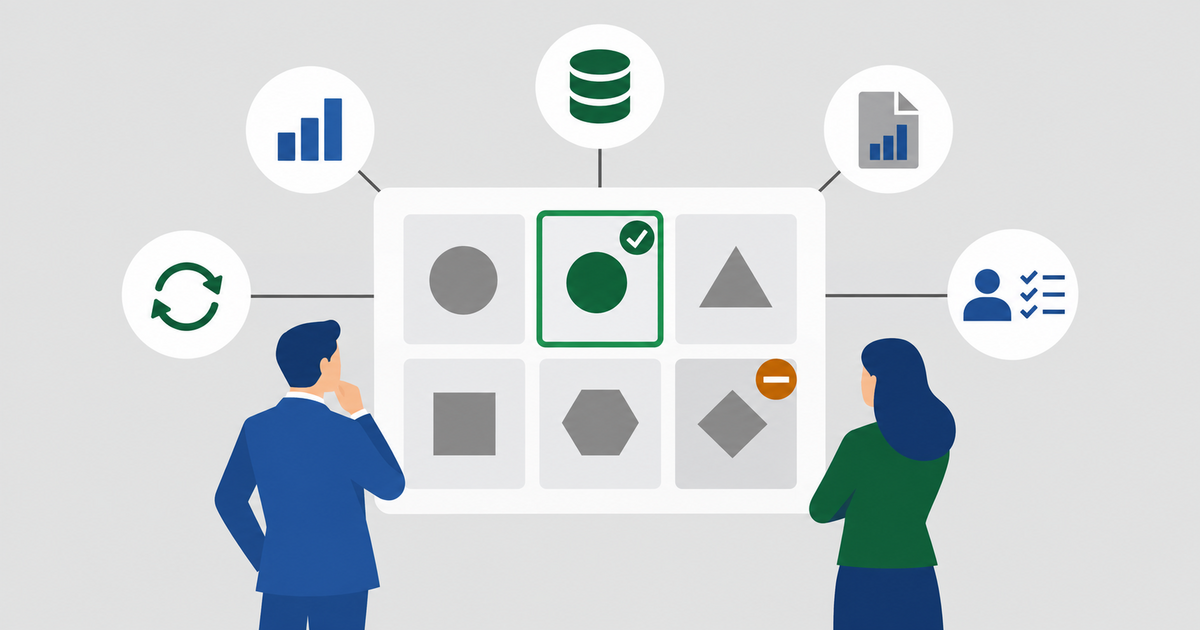
Your first AI use case does not need to be impressive. A useful starting point is a small, frequent task with available data, clear tests, and correctable mistakes.
What makes a good first AI use case?
Do not start with “Where could we use AI?” Start with a specific task that takes time or produces inconsistent results. Give it a clear beginning and end. “Assign incoming requests to a topic” can be tested. “Improve customer service with AI” is too broad.
The Mittelstand-Digital guide to AI use cases (opens in a new tab) recommends starting with a clearly bounded case and connects the goal, data, risks, and responsibilities in a use-case canvas. That order is useful because it examines the process before selecting technology.
How can you compare several ideas fairly?
Assess every idea with the same six questions. A basic scale and one reason per score are enough for the first comparison.
- Frequency or volume: How often does the task occur? A modest improvement can matter when the task is repeated regularly.
- Measurable baseline: Do you know the current handling time, error types, or rework? Without a baseline, any benefit remains a guess.
- Data readiness: Do you have examples, permitted sources, and expected outputs? Check quality, currency, access rights, and sensitive content.
- Risk and reversibility: What happens when the output is wrong? Can a person review it before it takes effect and reverse it easily?
- Named owner: Who decides on test cases, approval, operation, and stopping the trial? “The project team” is often too vague.
- Concrete test cases: Which common, difficult, and disallowed cases must the solution handle? Define the expected response before the first trial.
The KfW analysis of AI adoption in German SMEs (opens in a new tab) identifies usable data, skills, and digital maturity as important conditions. It also lists missing skills, limited time, weak data foundations, and concerns about security and reliability as barriers. Those factors belong in the selection process.
Why should the first task be small and bounded?
A bounded task lets you separate causes. Was the source wrong, the instruction unclear, the model unsuitable, or the process poorly described? In a large end-to-end project, these questions become tangled.
A small start does not mean the benefit must stay small. It produces tested data, real failure patterns, and a clear decision: expand, solve the problem another way, or stop. That decision is more useful than a demo that works only with prepared examples.
When is AI the wrong solution?
One migration required texts to be sorted by language. An AI language detection service looked like the obvious choice. For the limited set of languages, a deterministic check of common words and characters was enough. It cost less, was easier to explain, and did not require another service. We do not repeat an earlier general accuracy claim because no documented test supports it. Read the full example in “Does It Always Have to Be AI?”.
Your evaluation should therefore ask whether rules, search, or conventional automation can solve the task. AI is one option, not a requirement.
When should you stop an AI experiment?
We once tried to summarize PowerPoint files automatically. The extraction already failed to meet our needs: converting slides to PDF and running OCR produced badly separated characters and a lot of irrelevant content. The tested summaries and key phrases did not meet the actual requirement either. We stopped instead of building more technology around an unresolved input problem. The details are in our lessons from PowerPoint summaries.
Set those stop conditions in advance. Examples include missing minimum quality, excessive manual correction, no permitted data source, or a risk that cannot be limited sensibly.
How do you run the first test?
Choose one bounded task, one owner, and a fixed set of normal cases, edge cases, and cases the system must reject. Document today’s process and compare every result with expectations written before the test. Only then decide whether to add data, features, or an integration.
Have several ideas and need to choose the first AI use case? Contact us. We can help you define the task, data, risks, and test cases for a bounded start.
What Is the Next Step in Your Company?
Our page AI Consulting and AI Adoption explains how an AI rollout works, what drives the cost and how data protection and the works council come in. Get in touch if you want to plan the next step concretely.
Over 20 years of experience with development, SharePoint, and Microsoft 365. Sascha advises companies on implementing and optimizing digital workplaces – from strategy to technical implementation.
Learn more about the author →Contents
Related Content
Brilliant yet Clueless – The User Manual: Prompt Engineering, Model Selection, and How to Use AI Properly
26.03.2026Brilliant yet Clueless – The Fails: When the Gifted Agent Gets Spectacularly Dumb
12.03.2026Brilliant yet Clueless – The Superpowers: What AI Agents Actually Deliver in Development
05.03.2026Brilliant yet Clueless – The New Colleague: Why We "Hired" an AI Agent
26.02.2026